- Home
- >
- News
- >
- Company news
- >
- Belt Conveyor Selection
Belt Conveyor Selection
Belt Conveyor Selection: Flat, Chevron and Sidewall Belts
Belt conveyors are the most commonly used continuous conveying equipment in sand and gravel, mining, building materials and grain industries.
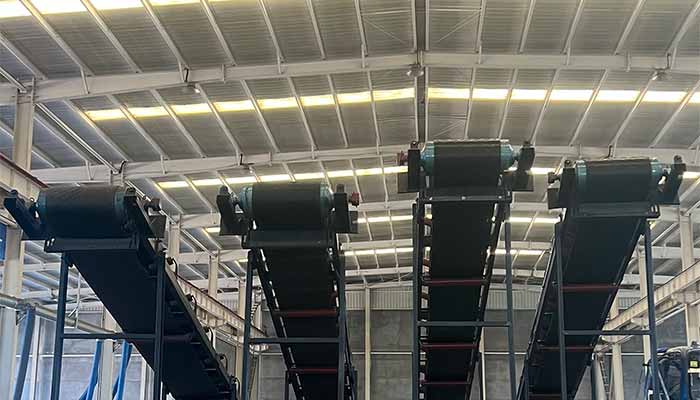
Customers often confuse ordinary flat belts, chevron belts and sidewall conveyor belts during selection. Wrong belt selection may lead to problems such as slipping, material backflow, material spillage and insufficient capacity.
Below is an introduction to the structural features, applicable inclination angles, suitable materials and working conditions of the three types of belts to facilitate scheme selection in the early stage of projects.
1. Ordinary Flat Belt
The ordinary flat belt is the most widely used conveyor belt. It has a smooth surface without patterns or sidewalls, featuring the simplest structure, lowest cost and easy maintenance. It can be fitted with trough idlers and is suitable for horizontal or low-inclination conveying.
- Recommended inclination angle: 0°~15°
- Advantages: Cost-effective, clean discharge, easy installation of scrapers, less material accumulation on the return side. It can convey lumpy, granular and bagged materials, and is also suitable for transporting finished materials after screening.
- Applicable materials: Dry sand and gravel, crushed stone, ore, bagged materials, grains.
- Suitable scenarios: Sites with no space restrictions and low inclination layout.
- Limitations: When the inclination angle increases, wet sand and fine powder materials are prone to slipping and backflow; not suitable for steep lifting.
2. Chevron Belt
The belt surface is equipped with raised V-shaped chevron patterns to increase friction. It is the mainstream anti-slip solution for medium and low-angle lifting and is widely adopted in sand plants.
- Recommended inclination angle: 15°~28° (common pattern height: 5–10 mm)
- Advantages: Good anti-slip performance, simple structure, the overall cost is much lower than sidewall belts; smooth material discharge.
- Applicable materials: Dry sand, crushed stone, coal, slag, grain, granular aggregates.
- Suitable scenarios: Stockpiling in sand washing plants, inclined feeding, stacking feeding, mobile loading conveyors.
- Limitations: Not suitable for steep angles above 30°, nor for highly flowable wet fine sand. When conveying wet sand above 25°, materials will still slide down along the gaps of the patterns, resulting in failure to reach the designed capacity.
3. Sidewall Conveyor Belt
It consists of a base belt, corrugated sidewalls on both sides and transverse cleats in the middle. The cleats and sidewalls form separate pockets to contain materials, making it a dedicated solution for high-angle conveying.
- Recommended inclination angle: 25°~60° (45° is a very common working condition)
- Advantages: Large conveying angle and small footprint. Materials are contained inside the cleat pockets, so highly flowable materials are less likely to spill or flow back. For the same lifting height, the overall conveyor length is much shorter than that of chevron belts, saving workshop space.
- Applicable materials: Granular materials with low moisture content.
- Suitable scenarios: Applications requiring high-angle feeding.
- Limitations: Higher belt cost, and stricter requirements for matching pulleys, idlers and frame structure.
CAFU Machinery customizes various belt conveyors according to material specific gravity, moisture content, target capacity and inclination angle. We will select the most suitable configuration based on your actual working conditions, including flat belts, chevron belts and sidewall conveyor belts. Auxiliary options such as motorized drums or brand-specified gear motors (e.g. SEW) are available to meet personalized requirements for different production lines.